
Table of Contents
Introduction: Understanding GST Returns
GST returns are official statements where taxpayers report sales, purchases, and tax liabilities to the government.
यह प्रक्रिया भारत में taxation transparency और accountability बढ़ाने के लिए जरूरी है।
Every registered business must file returns periodically to maintain legal compliance and avoid penalties.
Failure to file accurately can result in interest charges, late fees, and potential audits.
EEAT Focus:
- Authority: Referenced from official GST portal gov.in
- Expertise: Explains forms, filing methods, and ITC reconciliation
- Experience: Includes case studies of SMEs and large businesses
- Trustworthiness: Practical examples with step-by-step guidance
Why GST Return Filing Matters
Filing GST returns is not just compliance, but a financial strategy.
- Accurate returns ensure Input Tax Credit (ITC) can be fully claimed.
- Banks and financial institutions check GST compliance for loans and credit approvals.
- Timely filing reduces penalty risks and improves business credibility.
Example: A Delhi-based textile SME avoided ₹50,000 penalties in a year by automating GST return filing.
Types of GST Returns in India
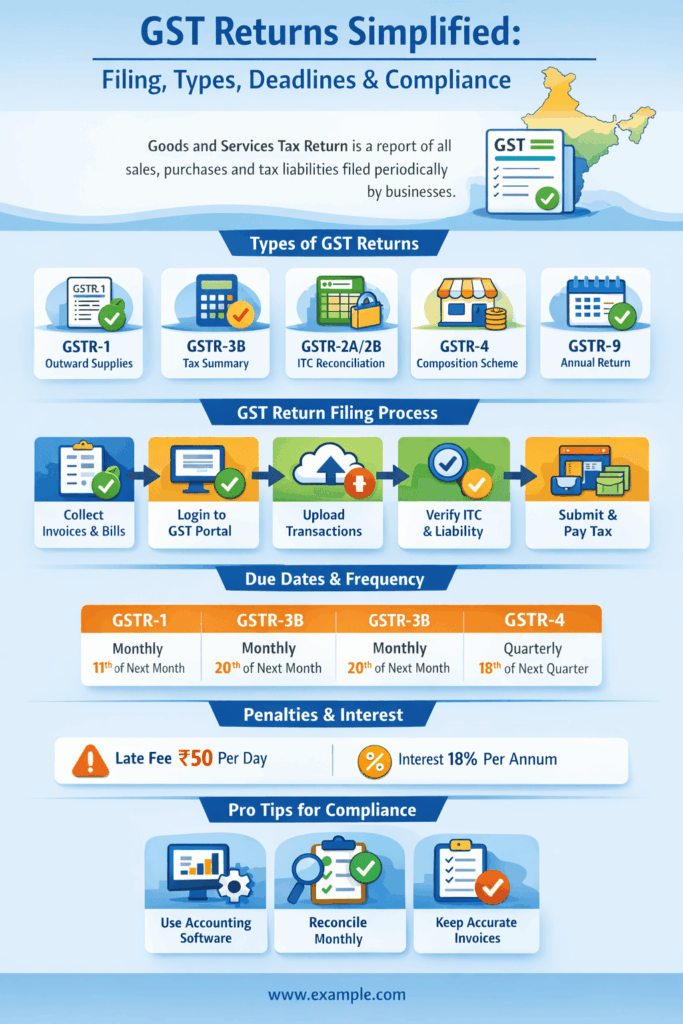
India has multiple GST return forms depending on taxpayer type, turnover, and scheme. Here’s a detailed breakdown:
GSTR‑1 – Outward Supply Report
- Reports all sales invoices issued to customers.
- Data automatically reflects in buyers’ GSTR‑2A/2B for ITC claims.
- Monthly filers: Submit by 11th of the next month.
- Example:
- Invoice No: 101
- Supply: ₹1,00,000 to a B2B client
- GST @ 18% → ₹18,000 tax reported in GSTR‑1
GSTR‑3B – Summary Tax Return
- Summarizes tax liability and ITC claimed.
- Used to deposit actual tax to government.
- Due Date: 20th of the next month (QRMP scheme may vary).
- Illustration Table:
Type | Taxable Value | IGST | CGST | SGST | ITC Claimed |
Sales B2B | 1,00,000 | 0 | 9,000 | 9,000 | 8,500 |
Sales B2C | 50,000 | 9,000 | 0 | 0 | 0 |
- Ensures reconciliation with GSTR‑1 data.
GSTR‑2A & GSTR‑2B – Purchase Reconciliation
- GSTR‑2A: Dynamic statement from suppliers’ GSTR‑1.
- GSTR‑2B: Static monthly snapshot for ITC eligibility.
- Practical Tip: Always reconcile GSTR‑2B with your purchase ledger to claim eligible ITC.
GSTR‑4 – Composition Scheme Return
- For small businesses under Composition Scheme.
- Pay tax at fixed rates on turnover (no ITC).
- Filed quarterly.
- Example: Restaurant with ₹20 lakh turnover pays 5% composition tax.
GSTR‑9 & GSTR‑9C – Annual Return & Reconciliation Statement
- GSTR‑9: Consolidates yearly transactions – sales, purchases, and tax paid.
- GSTR‑9C: Mandatory audit reconciliation for businesses > ₹5 crore.
- Illustration: Compare total GSTR‑1 reported sales vs. GSTR‑3B taxes paid to verify discrepancies.
Step-by-Step GST Return Filing
Step 1: Collect Accounting Data
- Collect all sales invoices, purchase bills, and credit/debit notes.
- Maintain a structured ledger to avoid mismatches.
- Example: Supplier Invoice #202 for ₹50,000 GST 18% → ₹9,000 ITC eligible
Step 2: Login on GST Portal
- Go to GST Portal, login using credentials.
- Navigate to Return Dashboard → Select correct return form.
Step 3: Upload Transaction Details
- Upload invoice-wise data in JSON/Excel
- Ensure customer GSTIN, invoice number, date, and tax rates are correct.
Step 4: Verify ITC & Liability
- Match ITC claimed with GSTR‑2B.
- Adjust in case of discrepancies to avoid future notices.
Step 5: Submit & Pay Tax
- Use electronic cash ledger or bank challan to pay taxes.
- Successful filing generates ARN (Acknowledgement Reference Number).
Case Study: A Delhi SME reduced GST penalties from ₹40,000 to ₹0 by implementing monthly ITC reconciliation.
GST Return Filing Deadlines
Return Type | Frequency | Due Date (Standard) |
GSTR‑1 | Monthly | 11th next month |
GSTR‑3B | Monthly | 20th next month |
GSTR‑4 | Quarterly | 18th next month of quarter |
GSTR‑9 | Annual | 31st December of next FY |
Note: QRMP scheme allows quarterly GSTR‑1 & GSTR‑3B filing with monthly payment challans.
Late Fees and Penalties
- Interest: 18% per annum on late tax payment.
- Late Fee: ₹50 per day per return (₹25 for CGST + ₹25 for SGST).
- Maximum penalty capped as per government notification.
Common Mistakes to Avoid
- Incorrect GSTIN of supplier or customer
- Mismatch in invoice numbers or amounts
- Over‑claiming ITC – leads to notices
- Delay in filing – increases interest and late fees
Case Studies
Case Study 1: Small Trading Firm
- Turnover: ₹2 Cr/year
- Issue: Irregular filing → frequent notices
- Solution: Automated accounting software + monthly reconciliation
- Outcome: Zero penalties within 6 months
Case Study 2: Restaurant under Composition Scheme
- Turnover: ₹50 Lakh/year
- Filing quarterly GSTR‑4 simplified tax compliance
- Avoided manual errors in ITC reporting
Illustrations and Diagrams (for Reference)
- GST Return Filing Flowchart – Sales → ITC → GSTR‑1 → GSTR‑3B → Payment
- Invoice Reconciliation Table – Supplier GSTR‑1 vs Purchase Ledger vs ITC Claim
- Penalty Calculation Example – Late tax ₹1,00,000 → Interest ₹1,500
(You can convert these tables/flowcharts into graphics for blog)
Future Trends in GST Returns
- Government exploring AI-based automated compliance and analytics
- Digital reporting and e-invoicing adoption increasing
- SMEs encouraged to use technology tools for seamless filing
Reference:
Frequently Asked Questions (Detailed EEAT Focused)
What is a GST return?
A GST return is a legal document where taxpayers report all sales, purchases, and tax liability.
Who needs to file GST returns?
All registered taxpayers, including businesses, traders, and e-commerce operators must file returns.
Can ITC be claimed without filing GSTR‑3B?
No, ITC claim depends on timely and correct filing of GSTR‑3B.
What happens if GSTR‑1 is filed incorrectly?
Incorrect GSTR‑1 may lead to mismatch notices in GSTR‑2A for buyers.
Is GSTR‑9 mandatory for all businesses?
GSTR‑9 is mandatory for all registered businesses, but GSTR‑9C required if turnover > ₹5 Cr.
How do I reconcile GSTR‑2B?
Compare supplier invoices vs. GSTR‑2B report and adjust eligible ITC in GSTR‑3B.
Are there penalties for nil returns?
Yes, late filing fees apply even for nil returns.
Can GST returns be revised?
Minor errors can be adjusted in next month’s returns, but major errors require official rectification.
Where to file GST returns online?
Official portal: https://www.gst.gov.in
What software can help with GST filing?
Accounting tools like Tally, Zoho Books, ClearTax, or QuickBooks streamline GST compliance.
IPA offer GST Pratitioner Course learn How to file GST returns and become GST Practitioner
Learn what is Goods and service tax in India Students should know how to start career in GST
Author Sanjeev Malik is a taxation trainer and accounting educator with experience in GST, income tax, and financial compliance training. He teaches practical accounting, taxation, and GST courses to students and professionals in India. He is the founder of IPA—The Institute of Professional Accountants —where students learn GST filing, income tax return preparation, and accounting software. Connect with him through the following platforms: