
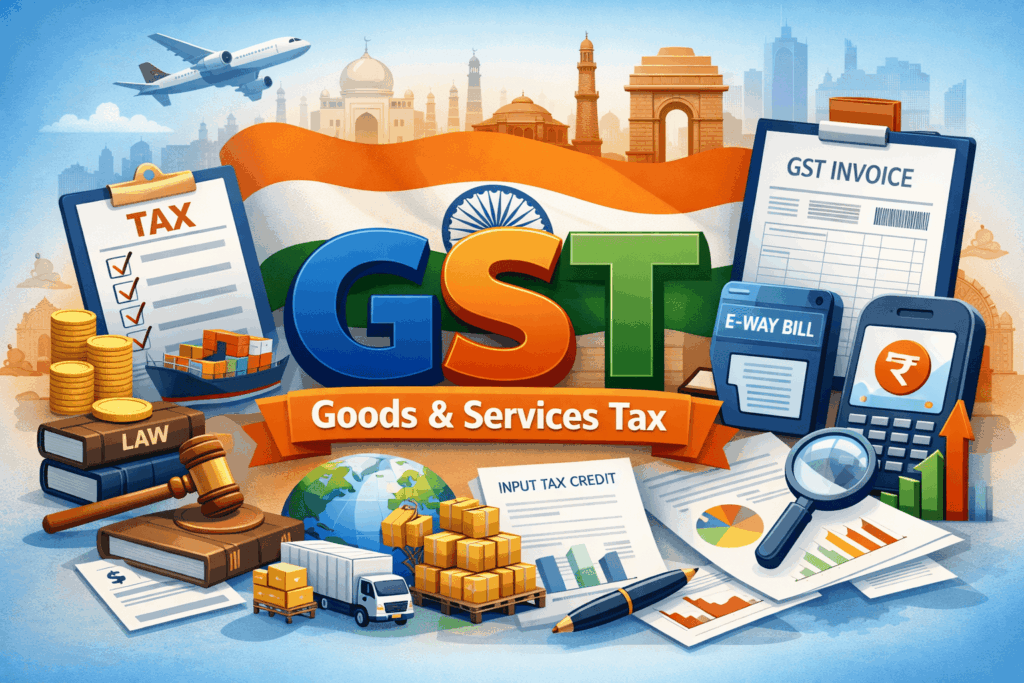
Goods and Services Tax (GST)
भारत में indirect taxation का सबसे महत्वपूर्ण कानून है, जिसे 1 जुलाई 2017 को लागू किया गया। GST ने इसे सरल बनाने के लिए एक unified tax system introduce किया, जो सभी राज्यों में समान rate और structure सुनिश्चित करता है। GST का मुख्य उद्देश्य केवल revenue collection नहीं है, बल्कि supply chain को transparent और efficient बनाना भी है। यह indirect tax system producers, wholesalers, retailers और consumers को सीधे प्रभावित करता है।
What Exactly is GST?
Goods and Services Tax कहते हैं। यह एक comprehensive indirect tax है, जो India में almost सभी goods और services पर लगाया जाता है। GST के अंतर्गत सभी stages of production और distribution पर tax लगता है, लेकिन इसे input tax credit mechanism के द्वारा offset किया जा सकता है। इसका मतलब है कि business केवल अपने added value पर tax pay करता है।
Example: अगर कोई manufacturer raw material खरीदता है और उस पर tax pay करता है, तो finished product बेचते समय वह tax credit use कर सकता है।
Key Features of GST
GST को unique बनाने वाले कई features हैं, जो इसे previous tax system से अलग करते हैं:
- Comprehensive Taxation: यह product और service दोनों पर लगने वाला single tax system है।
- Dual GST Structure: India में Central GST (CGST) और State GST (SGST) दोनों होते हैं। Inter-state supplies पर Integrated GST (IGST) लागू होता है।
- Input Tax Credit: यह mechanism businesses को अपने taxes set off करने का मौका देता है।
- Destination-Based Tax: Tax collection का निर्णय product या service के supply location पर आधारित होता है, न कि origin पर।
- Uniform Tax Rates: सभी states में similar tax slabs apply होते हैं, जिससे trade में efficiency बढ़ती है।
History of GST in India
भारत में GST की शुरुआत लंबे समय से विचाराधीन थी। 2000 के दशक में कई committees ने recommend किया कि India में single indirect tax system होना चाहिए।
- 2004: Kelkar committee ने recommendation दिया कि multiple indirect taxes को replace करके unified system लाना चाहिए।
- 2006–2016: कई GST bills और discussions Parliament में हुए।
- 2017: 1 July 2017 को India में GST implement हुआ। इस समय, India के सभी states और Union territories ने इसे adopt किया।
इस historical evolution ने India को modern taxation framework की ओर shift किया, जो global standards के साथ align है।
Types of GST in India
GST को तीन major types में बांटा गया है:
- Central GST (CGST)
- यह tax central government collect करती है जब transaction within the same state होती है।
- Example: Delhi में manufacturer product बेचता है और buyer भी Delhi में है, तो CGST लगेगा।
- State GST (SGST)
- यह state government collect करती है और same state में supply होने पर CGST के साथ apply होती है।
- Example: Delhi में sale होने पर Delhi government को SGST मिलता है।
- Integrated GST (IGST)
- यह inter-state supplies पर लगता है। Central government इसे collect करती है और फिर states में distribute करती है।
- Example: Delhi से Mumbai को goods supply होने पर IGST applicable होगा।
इस dual structure से tax collection efficient हुआ और state autonomy भी बनी रही।
Advantages of GST
GST implement होने से कई फायदे हुए हैं, जो business और consumers दोनों के लिए beneficial हैं:
- Simplified Tax Structure – अब अलग-अलग taxes की जगह single unified tax है।
- Avoidance of Cascading Effect – “tax on tax” eliminate हो गया है।
- Increased Compliance – Input Tax Credit mechanism से businesses को accurate reporting करनी पड़ती है।
- Boost to Economy – Efficient tax collection से revenue बढ़ा और trade barriers कम हुए।
- Consumer Benefits – Uniform tax rates और transparency से end consumers को price benefit मिलता है।
GST Rate Structure
India में GST rates 4 slabs में divide किए गए हैं, जो different categories के goods और services पर apply होते हैं:
- 5%: Essential goods, food items
- 12%: Processed goods, consumer products
- 18%: Standard goods and services
- 28%: Luxury goods, high-end services
कुछ items जैसे petroleum products, alcohol और stamp duty अभी भी GST के under नहीं आते।
Tip: Taxpayer हमेशा latest GST rate schedule check करें क्योंकि government periodically revise करती रहती है।
GST Compliance Process
GST में compliance करना business के लिए महत्वपूर्ण है। यह steps typically follow किए जाते हैं:
- GST Registration – Turnover threshold के अनुसार mandatory registration।
- GST Returns Filing – Monthly, quarterly या annual basis पर returns file करना।
- Input Tax Credit Claim – Purchases पर tax credit claim करना।
- Payment of Tax – GST portal के through electronically tax payment करना।
- Audits & Reconciliation – Periodically accounts reconcile करना और government के audit में compliant रहना।
Proper compliance से penalties और interest charges avoid किए जा सकते हैं।
Impact of GST on Businesses and Consumers
GST ने भारत की economy में एक significant बदलाव लाया है। पहले, अलग-अलग states और central taxes की वजह से businesses को multiple compliance और complex accounting systems manage करने पड़ते थे। अब GST के माध्यम से, companies को single, unified tax system में adapt करना पड़ता है।
Businesses के लिए सबसे बड़ा लाभ cascading effect का elimination है। Cascading effect मतलब, “tax on tax” जिसे previous tax structure में bear करना पड़ता था। Input Tax Credit के कारण companies केवल अपने value addition पर tax pay करती हैं, जिससे overall cost कम होता है।
Consumers के लिए भी GST beneficial है। अब goods और services पर transparent tax लगता है, जिससे price discrepancies reduce हो गए हैं। उदाहरण के तौर पर, यदि कोई manufacturer raw material खरीदता है और tax pay करता है, तो वह tax credit अपने final product के price से adjust कर सकता है।
Sector-wise Implementation of GST
GST सभी sectors पर लागू होता है, लेकिन कुछ sectors को special consideration मिलती है।
- Manufacturing Sector
- Raw material से finished goods तक सभी stages पर tax apply होता है।
- Input Tax Credit mechanism के कारण production cost कम होता है।
- Service Sector
- Services जैसे IT, consulting, healthcare, education पर भी GST लागू होता है।
- Previously service tax अलग-अलग rules के तहत था, लेकिन अब uniform slabs में apply होता है।
- E-commerce Sector
- Online platforms जैसे e-commerce पर भी GST mandatory है।
- Marketplace operators को collection and remittance की responsibility दी गई है।
- Small Businesses and MSMEs
- Threshold exemption के कारण small businesses के लिए simplified compliance available है।
- GST Composition Scheme भी छोटे traders के लिए flexible और cost-effective है।
Technology and GST: The Role of GSTN Portal
GST के implementation में technology का बहुत बड़ा योगदान है। GST Network (GSTN) portal ने India में digital tax compliance को सरल और efficient बनाया।
- Online Registration: GST portal पर businesses आसानी से register हो सकते हैं।
- Return Filing: Monthly, quarterly या annual returns online submit किए जाते हैं।
- Payment of Tax: Electronic payment mechanism से tax payment transparent और trackable होता है।
- Invoice Matching: Suppliers और recipients के invoices reconcile किए जा सकते हैं।
GSTN portal ने manual processes और paperwork को लगभग eliminate कर दिया है, जिससे fraud और errors कम हुए हैं।
Common Challenges Faced by Businesses under GST
हालांकि GST benefits provide करता है, लेकिन implementation में कुछ challenges भी हैं।
- Technical Glitches on GST Portal – कभी-कभी server errors और filing delays businesses के लिए problem create कर सकते हैं।
- Complex Return Filing – कुछ businesses multiple returns (GSTR-1, GSTR-3B) भरते समय confusion face करते हैं।
- Classification Issues – Goods और services की correct classification करना crucial है, otherwise penalties लग सकती हैं।
- Inter-state Compliance – IGST calculation और reporting inter-state trade में कठिनाई ला सकती है।
इन challenges को समझकर, businesses proper training और accounting software implement करके compliance efficiently manage कर सकते हैं।
GST and Economic Growth
GST ने India के GDP और economic environment को positive impact किया है।
- Ease of Doing Business – Simplified tax structure और single registration process ने India को business-friendly बनाया।
- Increased Tax Base – Wider coverage से government revenue बढ़ा, जिससे infrastructure और social welfare में invest किया जा सकता है।
- Formalization of Economy – Unorganized sector gradually GST में आया, जिससे tax compliance और transparency improve हुई।
- Boost to Exports – Zero-rated exports के कारण exporters को tax refund और input credit advantages मिलते हैं।
Misconceptions about GST
GST को लेकर कुछ common misconceptions भी circulate होती हैं, जिन्हें clarify करना जरूरी है:
- GST Only Increases Prices – वास्तव में, cascading tax effect remove होने से long-term में price stabilization हुआ है।
- GST Is Only for Big Businesses – Small traders और MSMEs भी GST compliant होना जरूरी है, लेकिन threshold exemptions और composition scheme available है।
- GST Replaces All Taxes – Petroleum products, alcohol और stamp duty अभी भी GST के under नहीं आते।
GST Compliance Tips for Businesses
Efficient GST compliance के लिए कुछ practical tips:
- Maintain Proper Records – All invoices, purchase bills और payments record करें।
- Use Accounting Software – Modern ERP systems और GST-enabled accounting software implement करें।
- Regular Reconciliation – Supplier और customer invoices reconcile करना जरूरी है।
- Timely Filing – Penalties और interest avoid करने के लिए deadlines strictly follow करें।
- Professional Consultation – GST consultant से professional advice लेने से complex situations handle होती हैं।
GST Calculation: How Taxes Are Computed
Understanding GST calculation is crucial for both businesses and consumers. GST is applied on the transaction value, which includes the cost of goods or services and any additional charges like freight, packing, or insurance, but excludes discounts offered before taxation.
For instance, अगर कोई manufacturer ₹1000 का product बेचता है और applicable GST rate 18% है, तो GST = ₹1000 × 18% = ₹180. Buyer effectively pays ₹1180.
Types of GST Calculations
- Intra-State Supply (CGST + SGST)
- Example: Product sold within Maharashtra.
- If GST rate is 18%, it is split: CGST 9% + SGST 9%.
- Calculation: ₹1000 × 9% = ₹90 (CGST), ₹1000 × 9% = ₹90 (SGST). Total ₹1000 + ₹180 = ₹1180.
- Inter-State Supply (IGST)
- Example: Product sold from Maharashtra to Delhi.
- Entire 18% GST is collected as IGST.
- Calculation: ₹1000 × 18% = ₹180 (IGST).
This structured calculation ensures uniformity across all transactions, removing ambiguity and promoting transparency.
Input Tax Credit Mechanism Explained
Input Tax Credit (ITC) is the backbone of GST. यह business को अपने tax liability को offset करने का मौका देता है। Businesses केवल अपने value addition पर tax pay करते हैं, न कि total sale value पर।
How ITC Works
- Suppose a manufacturer purchases raw materials worth ₹500 and pays 18% GST = ₹90.
- He converts raw material into finished goods and sells for ₹1000 at 18% GST = ₹180.
- Using ITC, manufacturer claims ₹90 (already paid) and pays only ₹90 to government.
यह mechanism cascading effect (tax on tax) को समाप्त करता है और trade को cost-effective बनाता है।
Conditions for Claiming ITC
- Purchase invoice must be valid and GST paid by supplier.
- Goods and services should be used for business purposes.
- Return filing and payment must be done timely.
- Certain restricted items, जैसे personal use items या exempted goods, पर ITC claim नहीं होता।
Special Provisions under GST
GST में कुछ special schemes और provisions भी हैं, जो specific businesses या sectors को आसान बनाते हैं:
1. Composition Scheme
- Small businesses के लिए आसान tax compliance structure।
- Turnover threshold ≤ ₹1.5 crore (varies by state).
- Flat tax rate 1–6% (depending on business type) on turnover rather than itemized GST.
- Filing is simplified: only quarterly returns required.
2. Exemptions and Zero-rated Goods
- कुछ goods and services पर GST exempt या zero-rated होता है।
- Exempt examples: basic food items, educational services.
- Zero-rated examples: exports, which allow refund of input taxes.
3. Reverse Charge Mechanism
- Normally, supplier collects GST, but under reverse charge, recipient is responsible.
- Example: Import of services from foreign vendor.
4. E-way Bill Compliance
- Goods movement across states requires e-way bill under GST.
- Ensures accountability and reduces evasion.
State-wise GST Examples
Different states follow the dual GST model, but tax collection and allocation differ slightly based on state legislation:
- Delhi: CGST + SGST apply for intra-state supply. Example: ₹1000 goods → CGST ₹90 + SGST ₹90.
- Maharashtra: Similar calculation, composition scheme available for small traders.
- Karnataka: Certain services have special rates (education, healthcare).
- West Bengal: Local exemptions for agricultural goods.
State-wise variations mainly focus on composition schemes, registration thresholds, and exemptions, keeping India’s federal structure intact.
GST for Different Industries
- Retail
- GST simplifies supply chain transparency.
- Input credit ensures fair pricing.
- E-commerce
- Platforms collect GST from sellers and remit centrally.
- Mandatory registration even for small sellers with certain turnover.
- Manufacturing
- Efficient ITC ensures cost reduction.
- Raw material to finished product workflow is streamlined.
- Services (IT, Healthcare, Education)
- IT services: 18% standard rate.
- Healthcare: mostly exempt except private hospitals.
- Education: educational services mostly exempt.
Common GST Mistakes Businesses Should Avoid
- Incorrect classification of goods or services.
- Late filing of GSTR-1, GSTR-3B, or annual returns.
- Failure to reconcile ITC claims with supplier invoices.
- Ignoring e-way bill requirements for inter-state supply.
- Misunderstanding threshold limits for registration.
Proper understanding and training can save businesses from penalties, interest, and legal complications.
GST on Imports and Exports
GST का international trade पर भी significant impact है। India में imports और exports पर GST की अलग नियमावली लागू होती है, जिससे trade smooth और transparent बनती है।
GST on Imports
- Import of goods और services पर Integrated GST (IGST) apply होता है।
- Importer को customs duty के साथ IGST pay करना होता है।
- IGST input credit के रूप में use किया जा सकता है, जिससे domestic transactions में tax burden कम होता है।
Example: यदि कोई company USA से raw material import करती है और IGST 18% applicable है, तो company इसे credit के रूप में अपने GST liability से adjust कर सकती है।
GST on Exports
- Exports को zero-rated supply माना जाता है।
- Exporter को input tax credit claim करने का अधिकार है।
- Refund mechanism: Exporter excess tax या input GST refund के लिए apply कर सकता है।
यह policy exporters को competitive advantage देती है और India के export sector को boost करती है।
GST Refunds and Compliance Audits
Businesses और taxpayers के लिए GST refund और audits दो महत्वपूर्ण compliance aspects हैं।
GST Refund
- Refund generally two types के होते हैं:
- Excess GST paid
- Zero-rated exports
- Claim process: GST portal पर application submit करना और government approval का wait करना।
- Refund timelines: Generally 60 days में refund process complete किया जाता है।
GST Compliance Audits
- Periodic audit ensure करता है कि businesses correctly ITC claim और GST pay कर रहे हैं।
- Audits में documentation, invoices, return reconciliation और e-way bill verification शामिल है।
- Proper audit से penalties और disputes avoid होते हैं।
GST Impact on Supply Chain and Pricing
GST ने India में supply chain और product pricing को fundamentally change किया है।
- Supply Chain Efficiency
- Previously, interstate movement पर multiple taxes लगे।
- अब, input tax credit mechanism और uniform rates के कारण logistics और warehousing cost कम हुई।
- Pricing Transparency
- Uniform tax slabs और input credit adjustment से product price clear और predictable है।
- Example: Retail price में hidden taxes नहीं रह गए।
- Business Decisions
- Companies अब production location, warehouse placement और interstate supply strategy optimize कर सकते हैं।
Real-life Case Studies for GST
Case Study 1: Manufacturing Company
- A Delhi-based manufacturer previously paid multiple taxes on raw materials and finished goods.
- Post-GST: ITC mechanism से total tax liability reduced by ~15–20%.
- Result: More competitive pricing, better cash flow, simplified accounting.
Case Study 2: E-commerce Platform
- An online marketplace handling multiple sellers across states faced complex VAT compliance.
- Post-GST: Single registration, IGST collection, and centralized reporting reduced administrative cost and errors.
Case Study 3: Export-oriented Business
- An export company supplying to Europe claimed zero-rated GST refunds on input goods.
- Refund process streamlined through GST portal, boosting liquidity and global competitiveness.
GST Challenges in Implementation
Despite clear benefits, कुछ practical challenges remain:
- Technology Dependence: Small businesses face difficulty in adapting to GST portal glitches.
- Classification Errors: Misclassification of goods/services leads to disputes.
- Awareness Gap: Some traders are unaware of exemptions, ITC rules, or reverse charge mechanism.
- State-specific Variations: Minor differences in thresholds and exemptions may confuse businesses operating in multiple states.
Addressing these challenges requires regular training, professional consultation, and robust accounting systems.
Future of GST in India
- Government continuously revises rates और simplifies processes.
- Expansion of e-invoicing और automated compliance expected to improve tax administration.
- Integration with international trade agreements may further facilitate exports.
- Focus on digital tax compliance ensures transparency, reduces evasion, and strengthens the formal economy.
GST, therefore, is not just a tax; यह economic reform का हिस्सा है, जो India को modern, business-friendly, और globally competitive बनाता है।
Frequently Asked Questions (FAQs) on GST
1. What is GST and why was it introduced in India?
Answer: GST, या Goods and Services Tax, एक unified indirect tax system है, जिसे 1 जुलाई 2017 से लागू किया गया। इसका उद्देश्य भारत के fragmented tax structure को simplify करना, trade में transparency लाना और cascading effect (tax on tax) खत्म करना है।
2. How does Input Tax Credit (ITC) work under GST?
Answer: ITC mechanism businesses को उनके already paid GST को adjust करने की अनुमति देता है। यदि कोई manufacturer raw material पर GST pay करता है, तो finished product बेचते समय वह tax credit claim कर सकता है, जिससे केवल net tax pay करना पड़ता है।
3. What are the different types of GST in India?
Answer: India में तीन types of GST हैं:
- Central GST (CGST) – intra-state supply पर central government collect करती है।
- State GST (SGST) – intra-state supply पर state government collect करती है।
- Integrated GST (IGST) – inter-state supply और imports पर apply होता है।
4. Are all goods and services taxed under GST?
Answer: नहीं। कुछ items जैसे basic food products, educational services, healthcare, और exports या zero-rated supplies पर GST exempt या zero-rated होता है। Petroleum products, alcohol और stamp duties अभी भी GST के under नहीं आते।
5. What are GST slabs in India?
Answer: GST rates four major slabs में divided हैं: 5%, 12%, 18%, और 28%। Essential goods और food items 5%, processed consumer goods 12%, standard goods/services 18%, और luxury goods/services 28% पर taxed होते हैं।
6. How does GST affect consumers?
Answer: Consumers को transparent pricing और uniform tax rates का benefit मिलता है। Cascading effect remove होने से product cost realistically reflect होती है और unnecessary taxation avoid होता है।
7. What is the GST Composition Scheme?
Answer: Small businesses के लिए simplified scheme है। Turnover threshold ≤ ₹1.5 crore (varies by state) वाले traders को flat tax rate (1–6%) apply होता है और quarterly returns file करना होता है, जिससे compliance आसान हो जाता है।
8. How does GST impact exports?
Answer: Exports are zero-rated supply under GST। Exporters input taxes refund claim कर सकते हैं, जिससे liquidity improve होती है और India के exporters global competitiveness achieve कर पाते हैं।
9. What is Reverse Charge Mechanism in GST?
Answer: Normally, supplier GST collect करता है। Reverse charge में, recipient responsible होता है। Example: Import of services from foreign vendors।
10. How can businesses avoid GST penalties?
Answer: Businesses timely return file करें, invoices reconcile करें, ITC properly claim करें, और GST portal compliance maintain करें। Professional consultation और accounting software implement करना भी जरूरी है।
11. Are there online resources to check GST rates?
Answer: हाँ, official GST portal (www.gst.gov.in) regularly update करता है rates, notifications और guidelines। Businesses को यह source reliable और up-to-date information के लिए use करना चाहिए।
12. Can GST rates change over time?
Answer: हाँ, government periodically GST Council के through rates revise करती रहती है। Traders और consumers को latest notifications follow करना जरूरी है।
13. How does GST improve India’s economy?
Answer: GST increase करता है revenue collection, reduces tax evasion, formalizes economy, और supply chain efficiency बढ़ाता है। इसके कारण trade facilitation और ease of doing business भी improve हुआ है।
14. What are common misconceptions about GST?
Answer:
- GST केवल prices बढ़ाता है → Actually, cascading effect remove होने से price stabilization हुआ।
- GST सिर्फ big businesses के लिए है → Threshold exemptions और composition scheme small businesses के लिए भी है।
- GST सभी taxes replace करता है → कुछ items जैसे petroleum और alcohol अभी भी outside GST हैं।
15. How does GST affect small traders?
Answer: Small traders threshold exemption और composition scheme के under simplified compliance का लाभ लेते हैं। उन्हें quarterly returns file करनी होती हैं और flat tax rate pay करना होता है।
Summary and Key Takeaways
- Unified Tax System: GST replaced multiple taxes with a single, destination-based system.
- Input Tax Credit: Businesses only pay tax on value addition, avoiding double taxation.
- Dual Structure: CGST + SGST for intra-state, IGST for inter-state.
- Transparency: Pricing clear, tax collection streamlined, compliance digitized.
- Special Schemes: Composition scheme, exemptions, and zero-rated exports simplify compliance.
- Economic Impact: Boosts ease of doing business, formalizes economy, encourages exports.
- Digital Compliance: GSTN portal makes registration, return filing, and refunds seamless.
Final Tips for Businesses and Individuals:
- Keep accurate records of all invoices and purchases.
- File returns timely and reconcile ITC claims monthly.
- Stay updated on rate changes and exemptions.
- Utilize professional accounting software for efficiency.
- Consult GST professionals for complex transactions or audits.
GST is not just a tax reform; यह India के business ecosystem और economic growth के लिए foundational framework बन गया है। Proper understanding, compliance, और timely updates से businesses और consumers दोनों को long-term benefits मिलते हैं।
If you want to learn more about GST, join IPA GST Course