
Table of Contents
Introduction: Understanding TDS in India
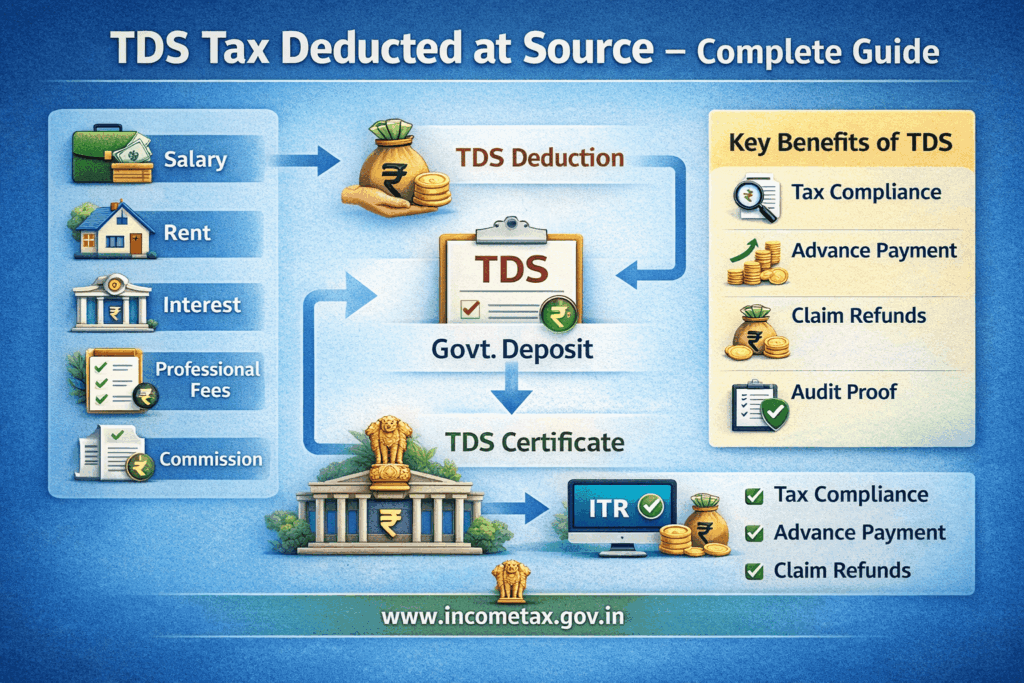
TDS या Tax Deducted at Source एक proactive tax collection mechanism है।
इस system में taxpayer को income receive होने से पहले tax collect किया जाता है।
This ensures compliance और taxpayers के लिए advance tax payment secure होता है।
Government को regular revenue मिलती है, और large-scale tax evasion कम होता है।
TDS सिर्फ salary या fixed income पर नहीं, बल्कि multiple income streams पर apply होता है।
यह mechanism advance tax adjustment और refund facilitation में भी critical role play करता है।
Official reference:
https://www.incometax.gov.in
Why TDS is Important – Significance Explained
TDS का उद्देश्य केवल tax collection नहीं, बल्कि financial discipline enforce करना भी है।
- Advance tax ensure करता है कि taxpayers timely contribute करें।
- Continuous tax collection से government budget planning आसान होता है।
- Taxpayer के perspective से यह refund claims और loan approvals में मदद करता है।
Practical Illustration:
Suppose Mr. Sharma earns a ₹1,500,000 salary per year.
If employer deducts 10% TDS on professional allowances, ₹1,50,000 पहले ही government को paid होता है।
जब Mr. Sharma files ITR, adjusted tax liability के बाद refund ₹20,000 back आता है।
यह example दिखाता है कि TDS cash flow और compliance दोनों manage करता है।
Types of TDS and Applicable Sections
TDS कई income types और transactions पर लागू होता है।
हम इसे categorize करके समझ सकते हैं:
1. TDS on Salary – Section 192
- Employer salary payment पर TDS deduct करता है।
- Rate depends on the employee’s income slab पर।
- Example: ₹50,000 monthly salary पर 10% TDS deduction = ₹5,000/month.
2. TDS on Interest Income – Section 194A
- Banks और financial institutions interest पर TDS deduct करते हैं।
- Threshold: ₹40,000 (non-senior citizen), ₹50,000 (senior citizen).
- Case Study: Ms. Mehta has ₹1,00,000 FD interest → ₹10,000 TDS deducted.
She can claim tax refund if total tax liability is lower.
3. TDS on Rent – Section 194I
- Rent > ₹240,000/year पर TDS mandatory होती है।
- Tenant deduct करता है 10% TDS और deposit करता है government में।
- Illustration: Mr. Verma pays ₹25,000/month rent → annual ₹3,00,000 → ₹30,000 TDS deposit.
4. TDS on Professional Fees – Section 194J
- Applicable for consultants, lawyers, architects, and freelancers.
- Standard rate 10% if PAN provided; 20% otherwise.
- Real Example: A freelance designer receives ₹500,000 → TDS ₹50,000 deducted.
Designer files ITR → claims tax credit → reduces overall liability.
5. TDS on Commission – Section 194H
- Business commission payments are TDS liable at 5%.
- Case Illustration: Insurance agent earns ₹300,000 commission → ₹15,000 TDS deducted.
Other Categories
- TDS on contract payments, dividends, insurance commission, etc.
- Specialized thresholds and exemptions exist for NRIs, charitable organizations, and government bodies.
TDS Deduction Process – Step by Step with Case Study
TDS deduction involves 5 major steps.
Step 1: Applicability Check
- The payer checks if payment exceeds the threshold.
- Example: Mr. Gupta pays Rs 250,000 annual rent → threshold ₹240,000 exceeded → TDS applicable.
Step 2: TDS Calculation
- TDS = Payment Amount × Applicable Rate
- Case: Rs 2,50,000 × 10% = Rs 25,000 TDS.
Step 3: Deduction at Payment
- Payer deducts TDS before remitting payment to payee.
- Rs 2,50,000 – Rs 25,000 = Rs 225,000 received by the landlord.
Step 4: Deposit to Government
- Deposit TDS within 7th of next month via authorized banks or portal.
- Delay → Interest & Penalty under Section 201/234A applicable.
Step 5: Issue TDS Certificate
- Form 16A issued to payee as proof.
- Example: Landlord uses this certificate for ITR filing → claims TDS credit.
TDS Rates – Detailed Table
Payment Type | Section | TDS Rate | Threshold | Notes |
Salary | 192 | As per slab | NA | Employee’s total tax liability adjusted |
FD Interest | 194A | 10% | Rs 40,000 | Senior citizens ₹50,000 |
Rent >2.4L | 194I | 10% | Rs 2,40,000 | Residential & commercial rent |
Professional Fees | 194J | 10% | Rs 30,000 | PAN mandatory for 10% rate |
Commission/Brokerage | 194H | 5% | Rs 15,000 | Commission paid to individuals |
Form 16, 16A, and Form 26AS – Practical Understanding
Form 16
- Salary TDS proof, issued by employer.
- Contains a detailed breakup: salary, deductions, and TDS deposited.
Form 16A
- Non-salary TDS certificate.
- Issued quarterly for rent, professional fees, commission.
Form 26AS
- Consolidated tax credit statement.
- Shows all TDS, TCS, advance tax.
- Real-life check: Mr. Shah verifies ₹60,000 TDS from multiple sources → ensures correct ITR credit.
Case Study: TDS on Freelance Income
Scenario:
Ms. Anjali is a freelance consultant. Annual professional fees: ₹10,00,000.
Step 1: Client deducts TDS @10% = ₹1,00,000.
Step 2: TDS deposited to IT department by client.
Step 3: Ms. Anjali files ITR → sees ₹100,000 TDS credit in Form 26AS.
Step 4: Total tax liability is ₹90,000 → she claims a refund of ₹10,000.
Learning: TDS ensures advanced tax compliance, but a refund claim requires accurate ITR filing.
Benefits of TDS – Practical Advantages
For Taxpayers:
- Advance tax compliance automatic
- Reduces lump-sum tax burden
- Easy loan approval, visa, and credit checks
For Government:
- Consistent revenue stream
- Minimizes tax evasion
- Simplifies audit and monitoring processes
Illustration:
Company deducts TDS on employee salaries + contractor payments → government revenue predictably increases.
Common Mistakes and How to Avoid
- PAN mismatch → Form 26AS mismatch → refund delay
- Late deposit → interest charges under 201/234A
- Incorrect TDS certificate → payee compliance issues
- Threshold miscalculation → over/under deduction
Pro Tip: Always verify TDS entries in Form 26AS before filing ITR.
TDS Filing Deadlines
Filing Type | Deadline | Notes |
Monthly Deposit | 7th of next month | Delay → Interest under Sec 201/234A |
Quarterly Return | 31 July, 31 Oct, 31 Jan, 31 May | Form 24Q/26Q filing |
Annual Certificate | 31 May | Issue Form 16/16A |
Illustrative Example – TDS on Multiple Income Streams
Mr. Rakesh Scenario:
- Salary: ₹1,200,000 → Employer deducts ₹120,000 TDS
- FD Interest: ₹50,000 → Bank deducts ₹5,000 TDS
- Rent Income: ₹300,000 → Tenant deducts ₹30,000 TDS
Total TDS Credit: ₹155,000
Actual Tax Liability: ₹140,000
Refund Due: ₹15,000
Insight: Proper TDS tracking ensures accurate tax credits and refunds.
FAQs – Deep and Varied
FAQ 1: What is TDS tax in India?
TDS is Tax Deducted at Source, collected before the payee receives income.
FAQ 2: Who deducts TDS?
Employers, banks, tenants, and businesses deduct TDS when payments cross thresholds.
FAQ 3: How is TDS calculated?
TDS = Payment × Applicable Rate. PAN availability affects rate (10% vs 20%).
FAQ 4: What is Form 16/16A?
Form 16: Salary TDS certificate. Form 16A: Non-salary TDS certificate issued quarterly.
FAQ 5: Can TDS be claimed as a refund?
Yes, after filing ITR, verify Form 26AS and claim excess TDS as a refund.
FAQ 6: What happens if TDS is not deposited?
Interest, penalties, and IT notices are triggered under Sections 201/234A.
FAQ 7: Are NRIs subject to TDS?
Yes, with specific rates under Section 195 and applicable DTAA provisions.
FAQ 8: How to correct TDS mistakes?
Use the TRACES portal to submit revised TDS certificates and file ITR accordingly.
FAQ 9: Is TDS applicable on contract payments?
Yes, contracts exceeding thresholds attract TDS under Section 194C at 1–2%.
FAQ 10: Does TDS reduce overall tax liability?
TDS is an advance tax payment; actual liability is adjusted during ITR filing.
References
- Income Tax Department – https://www.incometax.gov.in
- TRACES Portal – https://www.tdscpc.gov.in
- Income Tax Act 1961 – https://www.indiacode.nic.in
- Government of India Finance – https://www.finmin.nic.in
- Sanjeev Malik is a taxation trainer and accounting educator with experience in GST, income tax, and financial compliance training. He teaches practical accounting, taxation, and GST courses to students and professionals in India. He is the founder of IPA—The Institute of Professional Accountants , where students learn GST filing, income tax return preparation, and accounting software.
- Connect with him through the following platforms:
- Institute Website: tipa.in
- YouTube Channel:
Facebook Page: