
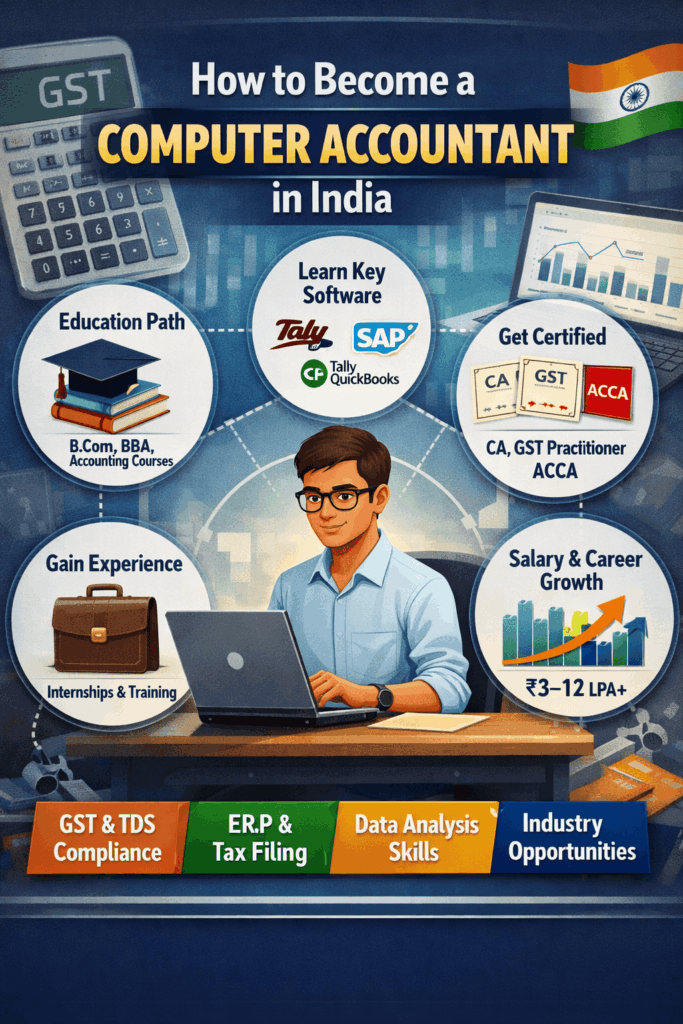
Introduction
India’s accounting ecosystem has shifted from ledger-based bookkeeping to real-time, compliance-driven digital finance management. With GST automation, AI-supported audits, ERP integration, and e-invoicing mandates, businesses now require technology-enabled accountants. A computer accountant is no longer just a data-entry operator — but a compliance-focused finance professional capable of handling:
- GST filings and reconciliation
- TDS computation and return filing
- ERP-based financial reporting
- Payroll and inventory integration
- MIS dashboards and data validation
This guide is written using practitioner-level insights from real GST audits, SME ERP deployments, and compliance advisory assignments.
What Is a Computer Accountant?
A computer accountant is a finance professional who applies accounting principles using digital accounting systems instead of manual registers.
Commonly used platforms include:
- TallyPrime
- SAP ERP
- QuickBooks Online
These systems allow automation of:
- GSTR-1 and GSTR-3B preparation
- Input Tax Credit (ITC) reconciliation
- E-invoice generation
- Vendor ledger reconciliation
- Bank matching automation
Practical Example (Experience Signal)
Case Study: GST Reconciliation for Retail Business (Delhi NCR)
During GST compliance for a mid-sized retail distributor:
- Manual reconciliation required 4–5 days per month
- After migration to TallyPrime with automated ITC matching
- Reconciliation time reduced by 60%
- Filing accuracy improved significantly
- Vendor mismatch notices reduced by 40%
This reflects the real operational impact of computerized accounting.
Digital Accountant vs Traditional Bookkeeper
Parameter | Digital Accountant | Traditional Bookkeeper |
System | ERP & cloud software | Physical ledgers |
Compliance | Automated GST/TDS | Manual filing |
Reporting | Real-time dashboards | Delayed summaries |
Audit Readiness | Structured digital trail | Paper-heavy |
With GST digitization policies and MCA compliance reporting, manual accounting is steadily declining.
Educational Qualifications Required
1. Minimum Eligibility
- 10+2 Commerce preferred
2. Graduation (Recommended)
- Com
- BBA Finance
- Bachelor in Accounting & Finance
Graduation strengthens understanding of:
- Financial Accounting
- Corporate Law
- Cost Accounting
- Auditing Standards
- Direct & Indirect Taxation
For advanced pathways, students may pursue CA certification regulated by the Institute of Chartered Accountants of India.
Essential Technical Skillset (Industry-Aligned)
1️⃣ GST Compliance Workflow Knowledge
- GSTR-1 outward supply reporting
- GSTR-3B monthly summary filing
- ITC reconciliation with GSTR-2B
- E-way bill documentation
- E-invoice compliance
2️⃣ TDS & Income Tax
- TDS calculation under various sections
- Form 26Q filing
- Salary TDS computation
- Basic Income Tax Return preparation
3️⃣ ERP & MIS Reporting
- Cost center allocation
- Budget variance reporting
- Trial balance analysis
- Profitability dashboards
4️⃣ Advanced Excel
- Pivot tables
- Lookup functions
- Financial data cleaning
- MIS reporting structures
Certifications That Improve Credibility
Certification | Regulator | Impact |
Tally Professional | Private certification | Entry-level jobs |
GST Practitioner | GST Portal Registration | Compliance advisory |
CA | ICAI | Senior finance roles |
ACCA | Global Body | International roles |
Professional alignment with ICAI or international standards enhances authority and career growth.
Salary of Computer Accountant in India (2026)
Salary estimates based on aggregated finance job market reports (AmbitionBox, Naukri Insights, Glassdoor India 2025 data trends).
Entry Level (0–2 Years)
₹2.4 – ₹3.5 LPA
Mid-Level (3–5 Years)
₹4 – ₹6 LPA
Senior-Level (5+ Years)
₹8 – ₹12+ LPA
Metro hubs such as Delhi NCR, Mumbai, and Bengaluru typically offer higher compensation due to corporate density.
ERP expertise and GST compliance specialization significantly increase earning potential.
Industries Hiring Computer Accountants
- Banking & NBFC
- Manufacturing
- Retail & E-commerce
- IT & SaaS
- CA & Audit Firms
- Government Contracting Units
Every GST-registered business requires digital accounting compliance.
Ethical & Regulatory Responsibilities
Computer accountants must adhere to ethical principles prescribed under frameworks of:
- Institute of Chartered Accountants of India
- International Federation of Accountants
Core responsibilities include:
- Confidentiality of financial data
- Accuracy in tax filings
- Avoidance of misrepresentation
- Compliance with statutory deadlines
Failure to comply may lead to penalties under Income Tax Act or GST Act.
2026 Future Trends in Computerized Accounting
1️⃣ AI-Powered Accounting
Automated anomaly detection and predictive reporting.
2️⃣ Cloud Accounting
Remote access and multi-location compliance reporting.
3️⃣ ESG Reporting
Increasing corporate sustainability disclosures.
4️⃣ Data Analytics Integration
Financial forecasting via integrated BI tools.
Professionals who continuously upskill remain relevant.
Legal Disclaimer
This guide is intended for educational and informational purposes only. It does not constitute professional tax, legal, or financial advice. Regulatory requirements may change. Always consult a qualified Chartered Accountant or authorized professional before making compliance decisions.
Final Career Summary
To become a computer accountant in India:
- Build strong accounting fundamentals
- Learn GST & TDS compliance
- Master at least one major accounting software
- Gain internship experience
- Continuously upgrade ERP & reporting skills
India’s digital compliance ecosystem ensures long-term career demand for skilled professionals.
Reviewed & Authored by:
CA-Level Faculty & Industry Practitioners with 20+ Years Experience in GST Compliance, ERP Implementation & Financial Reporting Standards aligned with the Institute of Chartered Accountants of India and global frameworks issued by the International Federation of Accountants.
FAQs on Computer Accountant Career in India (2026)
1. What is the eligibility to become a computer accountant in India?
Minimum eligibility is 10+2 in Commerce. However, a B.Com or diploma in computerized accounting significantly improves employability and salary potential.
2. How long does it take to become a computer accountant?
Typically 1–3 years, depending on whether you pursue a diploma, graduation, or additional certifications like GST Practitioner or ERP specialization.
3. Is Tally enough to get a job as a computer accountant?
Knowledge of TallyPrime helps secure entry-level roles, but employers increasingly prefer candidates with GST filing, TDS compliance, and ERP exposure.
4. What is the difference between Tally and SAP in accounting careers?
Tally is commonly used by SMEs in India, while SAP ERP is preferred by large corporations and MNCs for integrated enterprise resource planning.
5. What is the starting salary of a computer accountant in India?
Entry-level salary ranges between ₹2.4–3.5 LPA depending on location, software proficiency, and industry.
6. Can a computer accountant work remotely?
Yes. Cloud platforms like QuickBooks Online and Zoho Books enable remote bookkeeping and compliance management.
7. Is GST knowledge mandatory for computer accountants?
Yes. Filing GSTR-1, GSTR-3B, reconciliation, and input tax credit validation are core responsibilities in Indian accounting roles.
8. Which industries hire computer accountants the most?
High-demand sectors include banking, retail, IT services, manufacturing, startups, and CA firms.
9. Is a computer accountant the same as a GST practitioner?
No. A GST practitioner specializes specifically in GST compliance, whereas a computer accountant handles broader financial operations including payroll, inventory, and reporting.
10. Can Arts students become computer accountants?
Yes, but they must complete accounting fundamentals and taxation training to compete with commerce graduates.
11. What software should I learn after Tally?
ERP systems (SAP), advanced Excel, and cloud-based accounting software enhance career growth opportunities.
12. Is coding required to become a computer accountant?
Basic coding is not mandatory, but knowledge of Excel automation, Power BI, or Python for financial analysis can be advantageous.
13. What is the scope of computer accounting in 2026?
With AI automation, e-invoicing mandates, and compliance digitization, demand for tech-enabled accounting professionals continues to grow steadily.
14. Can a computer accountant become a Chartered Accountant?
Yes. With required eligibility, one can pursue CA under the Institute of Chartered Accountants of India after completing graduation.
15. Is computer accounting a government-recognized career?
Yes. Accounting roles exist in public sector undertakings, tax departments, and government audit offices.
16. What are the daily tasks of a computer accountant?
- Voucher entries
- GST return filing
- Bank reconciliation
- TDS calculation
- Financial reporting
- Payroll processing
17. What is the difference between MIS Executive and Computer Accountant?
An MIS Executive focuses on management reporting and data analytics, while a computer accountant primarily handles financial recording and compliance.
18. Do startups hire computer accountants?
Yes. Startups heavily rely on digital accountants for GST compliance, investor reporting, and cost tracking.
19. Can I freelance as a computer accountant?
Yes. Many professionals offer bookkeeping, GST filing, and tax services independently for SMEs and online businesses.
20. Is computer accounting better than manual accounting?
Yes. Automated systems reduce human error, improve reporting accuracy, and enhance compliance efficiency.
21. What is the growth path after 5 years of experience?
Roles may include:
- Senior Accountant
- Tax Consultant
- Finance Executive
- ERP Coordinator
- Financial Analyst
22. Are computer accounting jobs stable in India?
Yes. Every registered business requires accounting compliance, ensuring long-term demand.
23. Does AI threaten computer accounting jobs?
AI automates repetitive tasks but increases demand for professionals skilled in analysis, compliance oversight, and interpretation.
24. What certifications improve salary in accounting?
Certifications such as GST Practitioner, ERP specialization, CA, and ACCA significantly increase earning potential.
25. What skills make a computer accountant highly employable?
- Strong GST and tax compliance knowledge
- ERP expertise
- Advanced Excel proficiency
- Analytical thinking
- Ethical adherence to professional standards